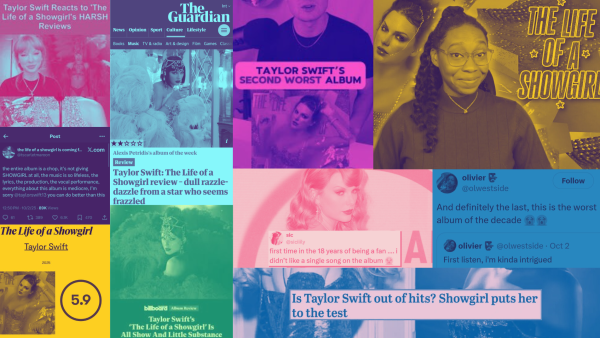
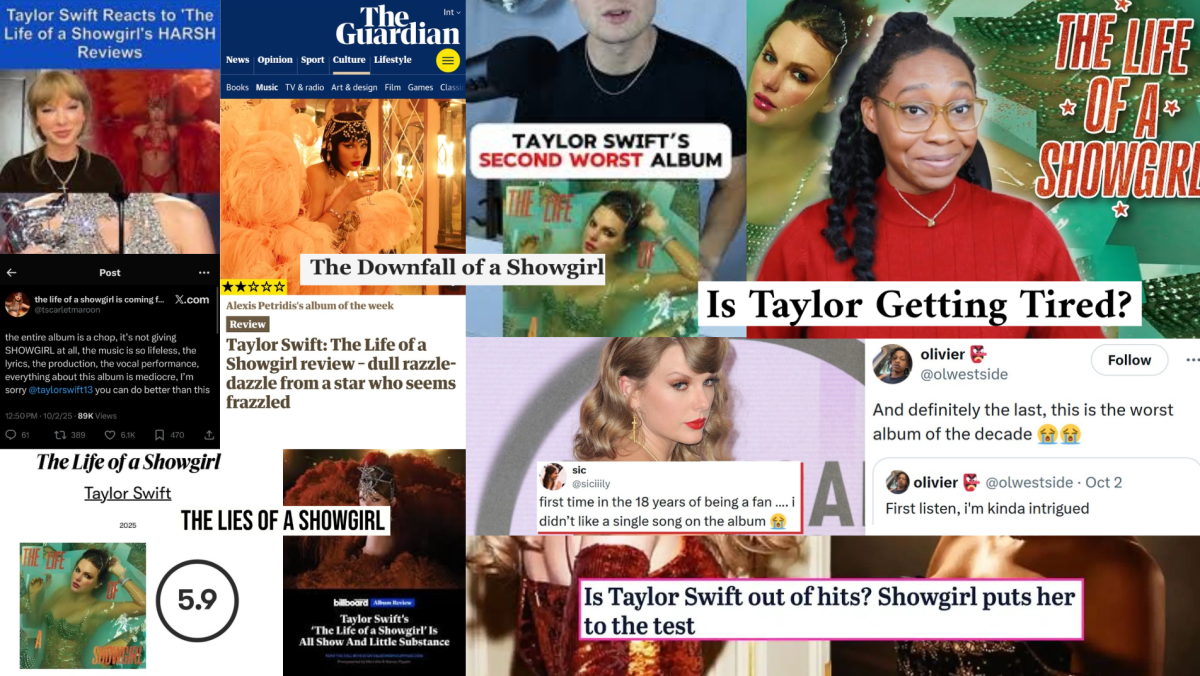
The release of Taylor Swift’s highly anticipated 12th studio album “The Life of a Showgirl,” created one of the most controversial and polarizing conversations in the lifetime of her career, but commercially it’s one of the biggest releases in not only the entirety of her catalog, but also the music industry itself. The divide between commercial success and the mix of critical reception tell two different stories.
Now that months have passed since the initial release of the album in early October of 2025, let’s explore the difference between critical failure and commercial success:
From the moment it dropped, “The Life of a Showgirl” broke tremendous amounts of records. It debuted with 4.002 million streams and sales. This is the largest first-week total ever recorded in the modern-era, surpassing Adele’s “25” for number one.
Tracks from the album generated over 1.5 billion global streams, and its songs filled the top spots on the Billboard Hot 100. Lead single of the album “The Fate of Ophelia” had just recently become Taylor Swift’s first song to spend 10 weeks at #1 on the Billboard Hot 100.
In terms of gross revenue, Billboard estimates the album brought in roughly $135 million within its first week alone. This is the best first-week in terms of profit Taylor Swift has had in her entire career, but critics disagree with the facts.
The release of “The Life of a Showgirl” came with many mixed emotions, but mostly with an influx of negative reviews. Pitchfork described the album as “a little schmaltzy,” stating it felt oversentimental, sloppy and ingenuine. They continued to describe it as musically familiar rather than groundbreaking, like many fans had hoped it would be.
One of the most notable criticisms of the record were the inconsistent songwriting, control issues between the concept and execution, and some lyrically awkward moments. An overwhelming amount of listeners online feel the album is uneven, citing specific moments in tracks “Favorite Daughter” and “Cancelled” as under-developed and uncomfortable.
Reviews aren’t only negative though. Rolling Stone rated the album five stars, praising its ambition and execution. Some commentators and fans admire the blend of upbeat instrumentals and narrative songwriting.
Many fans argue that the album’s energy and mood reflects Swift’s personal growth, highlighting joyful and celebratory themes, contrasting her previous album “The Tortured Poets Department,” Serving as a refreshing and fun break from her more introspective works, some fans see the album as a cultural force.
The debate itself helps solidify the album as a cultural event. The memes, hot takes, and intense discussion gives it more buzz, streams and sales. Swift herself has embraced the mixed reactions, stating how all opinions on the album are valid and a part of its overall impact.
If failure is defined as a unanimous critical acclaim, “The Life of a Showgirl” is most definitely not one. Though its reviews are clear, there is not an absolute consensus about the place of the album in pop culture. It’s not quite the phenomenon that “Folklore” or “1989” is in the eyes of reviewers, but it’s definitely not a disaster. Critics still found value and creativity in all of its songs.
Commercially, Swift’s 12th studio album is a clear win. It shattered first-week sales records globally, topped charts for weeks, and boosted Swift into rare industry territory historically shared with only the top artists of our generation. In terms of statistics, this album is in no way a financial or mainstream failure.
With all of this in mind, “The Life of a Showgirl” may be one of Taylor Swift’s most controversial albums, it proves exactly what it’s like to have the life of a showgirl. The numbers, conversations it started, and movements it made, show that the album is a significant cultural event.