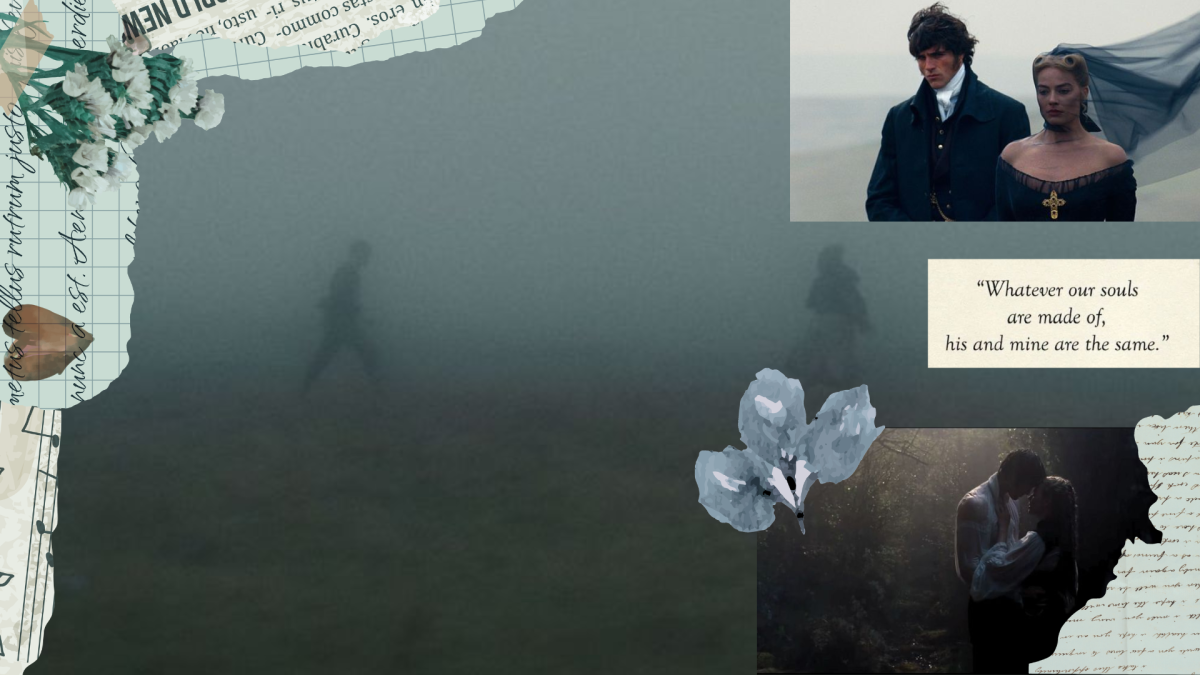
Since its publication in 1847, Emily Bronte’s classic novel “Wuthering Heights” has been adapted for the screen 14 times. In 2024, it was announced that Emerald Fennell, famous for directing the 2023 psychological thriller “Saltburn” would be directing an adaptation of the novel starring Margot Robbie as Catherine Earnshaw and Jacob Elordi as Healthcliff respectively.
In the wake of the announcement, the casting of Elordi was subjected to much criticism. The reason being is that Heathcliff in the novel is described as Romani with his race being a major factor in the novel’s events. The casting of Elordi, who is white ,erases a key aspect of the story. A huge reason Catherine and Heathcliff cannot be together is rooted in racism.
Catherine, who is white woman of a financially struggling but respected family is expected to marry a white man of higher status. The backlash against the adaptation only intensified when the trailer for the film was released, where Fennell’s vision was revealed to be a loose adaptation of the novel, reimagining the story as a straightforward forbidden romance rather than a meditation on generational trauma caused by miscommunication.
Following the release of the trailer, Fennell received more backlash for her blatant misinterpretation of the novel’s themes, accusing her of having not read the book before creating the film. On Feb. 13 just in time for Valentine’s day, the film was released in theaters.
The film does so much right, it technically can be considered a good film. The cinematography is breathtaking and beautifully showcases the set. The costumes, while not period accurate, are gorgeous. Margot Robbie and Jacob Elordi have incredible chemistry together and both give enchanting performances.
Charli XCX’s soundtrack, while an unconventional choice, is well crafted and easily addicting. It is such a shame all of these elements ended up being a part of a poorly adapted “Wuthering Heights” film.
Emerald Fennell’s choices as a director are appalling and borderline offensive to the original story. For starters, while Jacob Elordi gives a spellbinding performance as Healthcliff, it cannot be denied how white washing the character erases an essential aspect of the story making the story immediately separated from the source material.
However, the even stranger part of the casting is that Shazard Latif who plays Edgar Linton is a man of color. In the story, Catherine marries Edgar for financial security betraying her own love for Healthcliff. From the moment the film starts, the audience is meant to root for Catherine and Healthcliff to be together. By making Edgar, a man of color, be in competition with Healthcliff, a white man; it carries some unfortunate implications for the story.
Spoiler alert:
Speaking of the Lintons, the treatment of Isabella Linton within the story is horrific. In the original novel, Healthcliff marries Isabella to get back at Catherine and he mistreats and dehumanizes her. She even writes a letter to Nelly, a servant begging for help. In this film, Isabella is infantilized and acts more like a child than an adult woman which borders on uncomfortable, and when Healthcliff and her get married he mistreats her.
Instead of accurately showing the emotional turmoil the relationship takes on Isabella, the film depicts her enjoying the abuse he inflicts on her. This pushes the perspective that victims of domestic violence enjoy the torment their abuser inflicts on them. For Fennell to interpret Isabella’s story in this way, it is not a good look and creates doubt of if she understands the source material at hand.
If Fennell wanted to make a forbidden romance, that is perfectly acceptable. This film would not be controversial, Films are allowed to be loose adaptations of novels, and they are obliged to adhere to each aspect of a story but the problem is meant to be a “Wuthering Heights” adaptation and marketing it with taglines like “based on the greatest love story of all time” and “come undone” turn a story about generational trauma into a romance portrayed in a different light.
When asked about the lack of accuracy of the film Fennell said, “I knew right from the get-go I couldn’t ever hope to make anything that could even encompass the greatness of this book. All I could do was make a movie that made me feel the way the book made me feel.”
With this in mind, it’s clear that Fennell never intended to make an accurate adaptation which can work. Many inaccurate adaptations of classic literature exist such as “10 Things I Hate About You” and “Clueless” but why these films are so beloved by fans of the original novels is because while changes are made they still retain events and important details that are essential for retaining the novel’s essence and themes.
The problem with “Wuthering Heights” is that Fennell creating this film akin to how she pictured is that by doing so she is erasing the themes of the novel and altering how the story is perceived. “Wuthering Heights” is not a love story and was never intended to be. Fennell is a competent director; her other outings “Promising Young Women” and “Saltburn” are great films. She was just not the right person to make an adaptation of this material.