For many seniors at LTHS, the winter season is characterized by the anticipation for letters of acceptance to college. However, for students who wish to attend top business schools such as the University of Pennsylvania’s Wharton School or NYU Stern, the anxiety is further heightened by a conspicuous absence on their resume: membership in professional bodies such as DECA or the Future Business Leaders of America (FBLA).
Although LTHS offers a wide range of sports and arts programs, the absence of a business or finance club is more than a missed extracurricular activity: it is a barrier to college competitiveness and professional preparedness.
The Competitive Gap
In today’s college admissions process, “good grades” are simply the minimum requirement. Top business schools require “demonstrated interest,” which is fulfilled by involvement in case competition events, investment portfolio management or supervision of community service initiatives through recognized national chapters. Without DECA or FBLA, Lockport students lack the opportunity to compete regionally or nationally to demonstrate their ability to implement theoretical knowledge in practical situations.
“It feels like we’re starting the race ten yards behind everyone else,” said Jakub Sadowski, LTHS student planning to major in finance. “When you’re applying to competitive programs, you need to show you’ve already touched the industry. Without these clubs, we just don’t have that platform.”
A short drive away, students at Lemont High School and Carl Sandburg High School in Orland Park have the advantage of fully funded and active business chapters. When a Sandburg senior applies to a finance program with a regional DECA trophy on their mantle, and a Lockport senior applies with only a high GPA, the playing field is anything but level.
Many local business schools like Gies College of Business at UIUC expect students to not only have a perfect 4.0 GPA or a 36 ACT score, but also have some sort of experience outside of the classroom to understand the nuances of business and finance. Although it is true that Lockport has many different clubs for students to explore, many clubs are geared towards English, Political Science and Science majors which hurts students who want to gain further knowledge in the business world.
Some argue that students could simply solve the problem by starting a club, but that process is more difficult than people realize.
The “Pilot” Problem
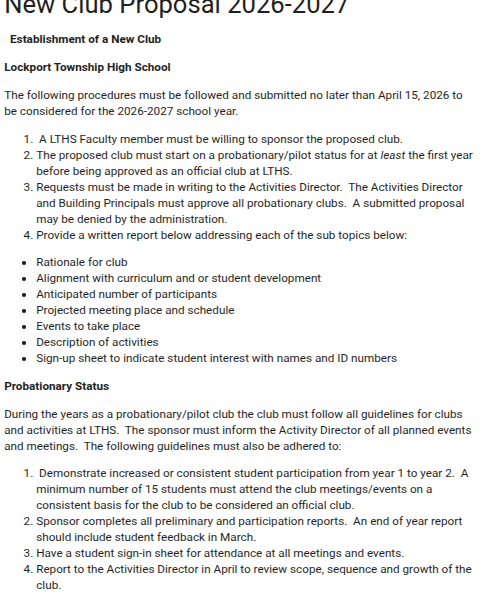
The problem here is not that Lockport students do not have the drive to begin such organizations; it is, instead, that the barrier to entry is prohibitively high. Currently, any new organization in the district must operate as a “pilot club“ for a full year before being recognized as an official organization.
“A year-long probationary period is an eternity for a senior or even a junior,” said George Mastorakos, an LTHS student aiming for a career in finance. “By the time the club is actually ‘official,’ the students who did all the legwork to start it have already graduated. We can’t even put a recognized organization on our transcripts during the critical fall application cycle.”
The Barrier of Unpaid Labor
Even if a group of motivated students can muster the necessary 15-student minimum to start a pilot, they are then faced with a secondary, more systemic barrier: finding a sponsor.
Under current rules, teachers who are willing to sponsor a pilot club must do so for free for an indefinite amount of time. It is a stretch to expect an educator, who is already balancing lesson plans, grading, and personal commitments, to stick around after school for several hours a week for an entire year without compensation. Even having a sponsor, and the necessary enrollment required for the club may not be enough due to the district deciding that the club does not align with the curriculum or student development at LTHS.
The lack of these clubs indicates a gap between the programming offered in high school and the needs of the global economy. Finance and business continue to be among the most popular college majors in the United States. By not offering a venue for these passions, LTHS is inadvertently communicating to the future entrepreneurs and CEOs of the school that their personal and professional growth is a secondary concern.
If the district wishes to continue its status as a top-tier district, it must make the process of forming career-based clubs easier. By shortening the pilot period and offering a small stipend to sponsors, the district can demonstrate to its students that it is committed to the varied career paths of its students.
Until this change is made, the future business leaders of Lockport will continue to stand on the sidelines as their counterparts in Lemont and Orland Park are given the edge that could very well define their futures.