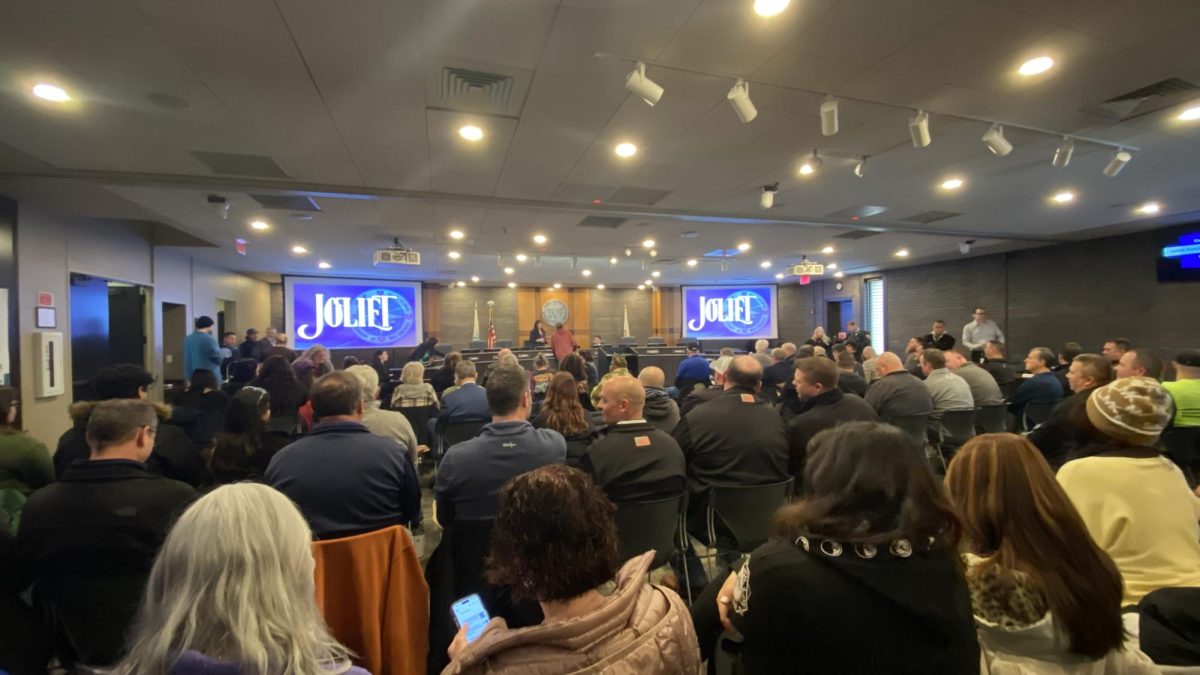
Weighing heavy pushback from local residents and strong support from local unions, the Joliet City Council on Thursday Mar. 19 voted 8-1 to approve a plan for a data center.
The Joliet Technology Center, proposed by Powerhouse Data Centers and Hillwood Investment Properties, will span 795 acres and will be located next to Chicagoland Speedway, south of downtown Joliet. It will primarily be used to support artificial intelligence.
The website for the project touts union jobs, tax revenue and partnerships with JJC as the top benefits the project will bring to the city. “The work stays here. The jobs stay here. The benefits stay here,” reads a banner on the site.
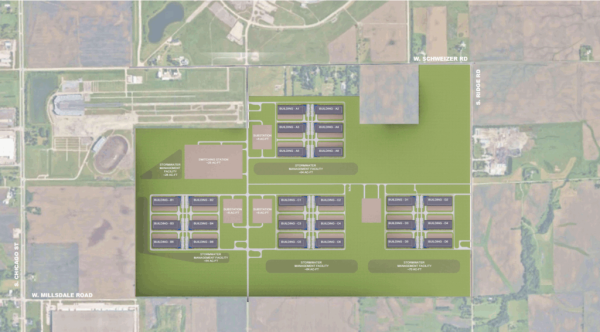
Photo Credit: Joliet Technology Center
The main supporters of the project were union workers, lured by the promise of 7,000 to 10,000 construction jobs over the course of five to seven years according to the project’s website. “The Joliet Technology Center is a great project,” Will & Grundy Counties Building Trades Council president Doc Gregory remarked at the March 16 meeting. “Our men and women need to work here in Joliet.” These jobs would come at a time when white-collar work is increasingly under threat by artificial intelligence.
Many opponents of the project whom Porter Press spoke to expressed concern over the speed with which the project was introduced as well as the environmental concerns, including Griselda Chavez, a member of advocacy group Warehouse Workers for Justice who printed out 150 signs reading “No data center in Joliet” to hand out to citizens during the March 16 meeting. Public comment, consisting mainly of opponents, lasted around six and a half hours, causing the vote to be moved later that week to Mar. 19.
Data centers are extremely power hungry buildings, running intensive servers and GPU’s 24/7. The Joliet Technology Center will reportedly use 1.8 gigawatts of power once online. One report found that the increase in data centers was responsible for ten-fold price increases in the PJM region, which is the energy market that operates in northern Illinois.
It has resulted in electricity bills soaring even for individuals that have decreased their electricity consumption. The developers of the Joliet Technology Center claim that electricity costs will not be passed on to local energy consumers.
Environmental concerns also remained for many residents, with water and noise pollution creating health issues for many nationwide communities housing data centers. The Joliet Technology Center claims that modern mechanical systems have made noise concerns “a concern of the past,” and that the data center’s cooling system “significantly [reduces] environmental impact and [preserves] local resources.”
Construction is expected to begin sometime in 2027 and will finish around 2032.